

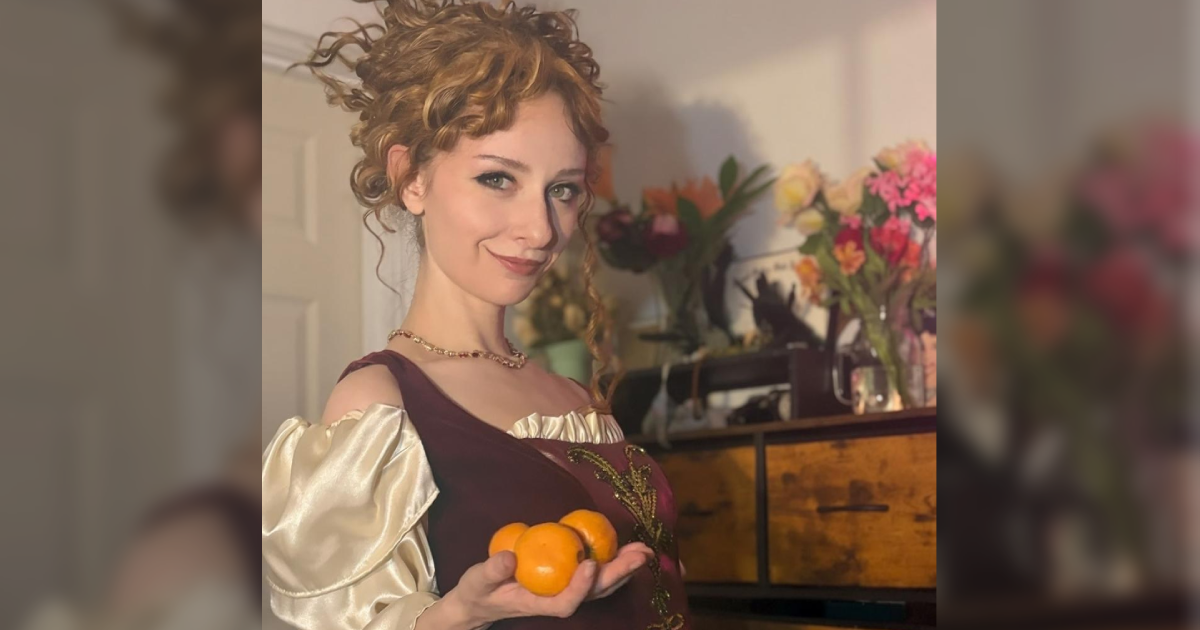
17th century writer, lawyer, and politician William Prynne wrote that “popular stage-playes are sinfull, heathenish, lewde, ungodly spectacles, and most pernicious corruptions.” Given that relatively widespread attitude, it’s perhaps unsurprising that English women weren’t allowed to act onstage.
It’s not that it was against the law (despite what many of us were taught); women could and sometimes did perform in amateur productions. But at the professional level, it just wasn’t done.
By the 1660s, that had begun to change. Suddenly, women were appearing on professional stages. For Othello, poet Thomas Jordan composed a new prologue calling attention to the fact that this production’s Desdemona would be played by a woman:
“I come, unknown to any of the rest
To tell you news; I saw the Lady drest;
The Woman playes to day, mistake me not,
No Man in Gown, or Page in Petty-Coat;
A Woman to my knowledge . . .”
Soon after, King Charles II made it official: women could play women. “Wee doe . . . permit and give leave That all the woemens part to be acted in either of the said two Companies for the time to come maie be performed by woemen,” he decreed. There are various theories as to why he made that decree: perhaps it was because he’d seen women onstage in France and realized they deserved to be there; perhaps it was at the request of a theatrical-minded lover; perhaps it was because he grew offended when a male actor was late due to last-minute shaving. Regardless, the declaration was made.
That momentous change is the background for April De Angelis’ Playhouse Creatures, which Pigeon Creek Shakespeare Company will stage this May. The play, directed by Muskegon Civic Theater’s artistic director Kristina McCloskey, will be onstage at three different venues: at the Stage at the Corner in Muskegon May 1st-2nd; the Sauk in Jonesville May 16th; and at Dog Story Theater in Grand Rapids May 22nd-24th. Nell Gwyn, Mary Betterton, Rebecca Marshall, and Elizabeth Farley.
The play features an all-women cast, four of whom portray real historical figures—Nell Gwyn, Elizabeth Farley, Rebecca Marshall, Mary Betterton—as well as Doll Common, a fictionalized amalgamation of various women. The characters bring diverse life experiences, ambitions, and anxieties, and are fully recognizable to modern audiences; these are not two-dimensional figures on a tapestry, but real women. As such, they both tend to, and bump up against, each other, helping and hurting as they do.
Katherine Mayberry, Executive Director of Pigeon Creek Shakespeare Company, calls the play both a drama and a comedy, one accessible to all audiences (at least those comfortable with PG-13 language and themes). The dialogue is recognizably modern, Mayberry said. While there are periodic play-within-a-play sequences, drawing from some real plays and some that seem to have been invented for Playhouse Creatures, she said that all viewers need to know is that women didn’t act onstage, and now, as the play begins, they do.
Asked why women weren’t allowed to perform onstage before that, Mayberry points to the fact that money exchanged hands. “The major thing seems to be women performing onstage in public and taking money for it. It was considered the moral equivalent of prostitution. They’d be displaying themselves onstage for money. And the theater was considered morally questionable anyway. This way, they were protected against moral offenses.”
That women should be free to make their own moral choices is clear to us today. It was less so, then. And, Mayberry points out, the liberation these women enjoyed was not complete, and was not without its perils. “They weren’t always taken seriously as actresses. Here they were, displaying their legs onstage. Some men among the nobility thought they deserved to keep actresses as affair partners. All they had to do was give them carriage rides and dresses in exchange—so they thought, anyway.”
Even today, she points out, men and women onstage and onscreen face different realities. “Marginalized groups tend to get to a certain point in equality and then bump up against an obstacle. It’s not exactly equal. You reach a point where you think you’ve achieved some kind of quality and then something within the structure comes into play. Even more subtle, implicit things, like the importance of women’s looks, and how they’re expected not to get older.”
The play will be performed on a relatively bare stage, allowing audience members to focus on the actresses (and their terrific costumes). That’s both true to the time period and a wise move, given that the show will be touring.
For all the seriousness of theme, Mayberry points out that the play is very entertaining. “It’s this very fun, fantastic cast. You have an opportunity to learn about history in this entertaining, moving way.
Playhouse Creatures
pcshakespeare.com/onstage
The Stage at the Corner
280 West Muskegon Avenue, Muskegon
May 1 & 2
eventbrite.com
Dog Story Theater
340 State St. SE, Grand Rapids
May 22-24
dogstorytheater.com
