

Known as the “Mother of Modern Dance”, Martha Graham wrote in her memoir Blood Memory that “the reason dance has held such an ageless magic for the world is that it has been the symbol of the performance of living.”
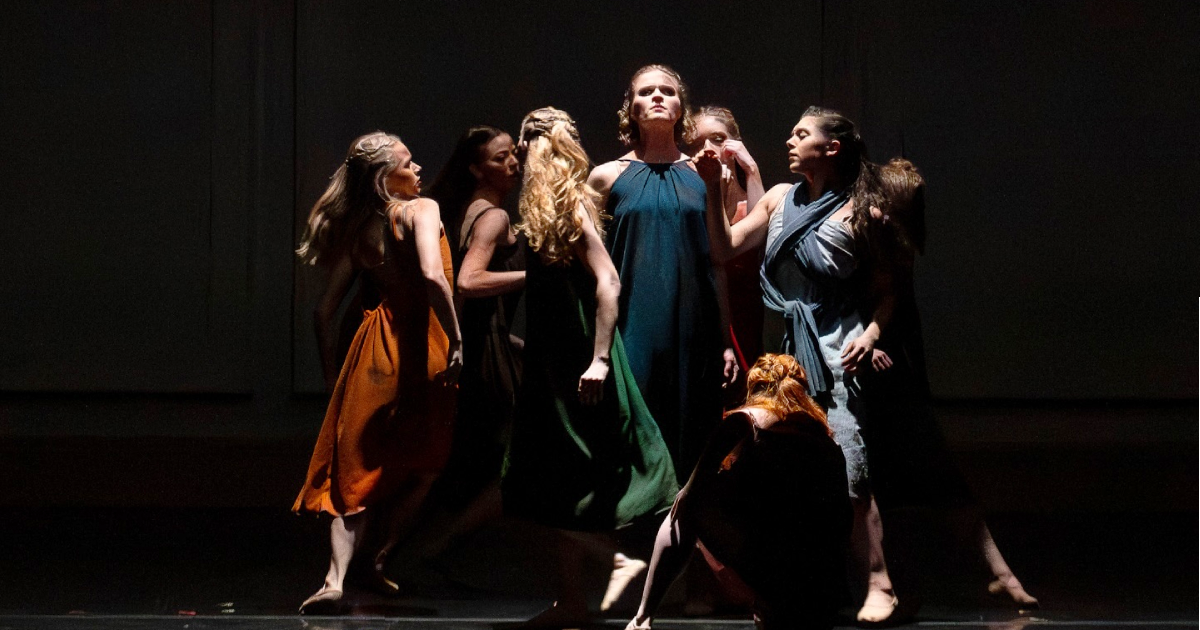
Deos Contemporary Ballet’s Ember Series 26, in production over the weekend at St. Cecilia’s in Grand Rapids, highlighted the experience of living, revealing especially the inner landscape of women in mourning, with just enough lightheartedness and joy to keep the audience from melting into their chairs with grief.
No doubt Graham would admire how effectively this small but mighty troupe of female dancers expressed often incomprehensible emotion with their bodies beautifully. In two acts and two hours, Ember Series 26 offered seven short works, including a reprisal of their Lamentations variations, inspired by Graham’s work, three brand new dances, as well as the world premiere of Artistic Director Tess Sinke’s ballet adaptation of Euripide’s Trojan Women.
Sinke is known for adapting classic literature into ballet. In their four seasons, Deos has brought to Grand Rapids stages her variations of Jane Eyre, The Tempest, and Trifles, among others, to great success.
With the 25-minute Trojan Women, a chorus of women, along with Hecuba, Cassandra, Andromache, and Helen of Troy, smeared in soot and wearing simple shifts, creep, crawl, cling, writhe, and pull themselves by their own hair in clusters and individually, effectively signally and creating the agonizing aftermath of war—set to Elani Karaindrou’s haunting score titled Trojan Women. Their grief is achingly palpable; however, individual characters and a discernible narrative arc isn’t as clear. This Trojan Women effectively expresses emotion rather than story.
The same could be said for much of the rest of the show, which transmits distinct mood and feeling in each short piece.
From last year’s Collide Series 25, returns Lamentations variations, three different choreographers’ and dancers’ reinterpretation of Martha Graham’s groundbreaking 1930 solo in which she wore a tube of of jersey fabric, stretching within, showing little more then her face, hands, and feet, to embody the universal, all-encompassing tragedy of grief and the ways it forces us to stretch within the boundaries of our own skin.
This section of the performance began with a rare video clip of one of Graham’s performances, followed by three powerful dances inspired by the original: the first choreographed by Christine Settembrino in which Madison Massara-Leister, wearing an oversized black T-shirt stands, reaches, and turns in a mournful way, effectively embodying grief. In the second, choreographed by Sinke, new company member Veronica Jaspers, from Nashville Ballet, very movingly embodies the experience and weight of grief itself, in a moving pas de deux with a black bench on which she balances but also lifts and carries on her back. a black bench. In the final piece of this section, choreographed by Amy Wilson, Allison Haan, barefoot in a green dress, begins in an overhead spotlight and pushes, pulls, reaches, runs, and crouches.
More variety of feeling comes with the other short works. A balance of light and dark, Madison Massara-Leister’s Reel Around The Sun is downright joyful with its quick foot work, sharp arms, and blend of classical ballet and traditional Irish dance. Tess Sinke’s Let’s Playreflects its title with three bare-legged dancers in black and white tennis dresses and soft shoes offer an energetic pas de trois with flexed feet and hands at the end of which they all fall to the ground playfully.
Madison Massara-Leister’s Past, Present, Future makes wonderful use of gorgeous, flowing white costumes with balayage effects at the hemline. There’s lovely tension in the solos, pas de deux, and ultimately pas de trois in the push-pull energy the dancers employ, and it’s lovely to watch the skirts move, even if the meaning and mood of the piece are somewhat unclear.
A delightful departure as part of this repertoire was celebrated Oregon Ballet Theatre resident choreographer Dennis Spaight’s 1979 Crayola. With no music and floor microphones, six dancers in solid block 1930s-style costumes and point shoes use white cane-backed chairs to create formations, move synchronously, and highlight the sounds of dance, from the thwack of pointe shoes on floor to the stretch and pull of the fabric, to the squeak of chair leg on floor. Every movement, no matter how small, feels enormous and utterly precise, from the turn of a head to a cross of the leg, to a grand battement and arabesque with a twist. It’s a gorgeous, intricate, special piece rarely performed—and presented here exquisitely.
In its fourth season, this professional company of six dancers, all women, continue to stretch, explore, and refine their artistry. In honor of Women’s History Month, Deos Contemporary Ballet’s Ember Series 26, offered a largely bleak expression of women’s lives—past, present, and future. And with a little bit of joy and color to buoy the overall effect, it’s a true expression, often beautiful, always well crafted, by capable, talented artists—who are also athletes of God, as Graham suggested.
See more of Deos Ballet in May with the Awaken series.
Ember Series 26
Deos Contemporary Ballet
March 21-22
https://www.deosballet.com/2025-2026-season/ember-series-26
