
The future comes beautifully framed in “Maybe Happy Ending,” the 2024 six-time Tony Award-winning, little musical with an expansive visual imagination in which two robots discover some enduring complications of being human.
In its first national tour, currently in production as part of Broadway Grand Rapids’ season at DeVos Performance Hall, the innovative musical by Will Aronson and Hue Park surrounds a simple love story with ingenious stagecraft. Its futuristic world is full of nostalgia, its technological wonders opening windows onto a past its characters cannot quite leave behind.
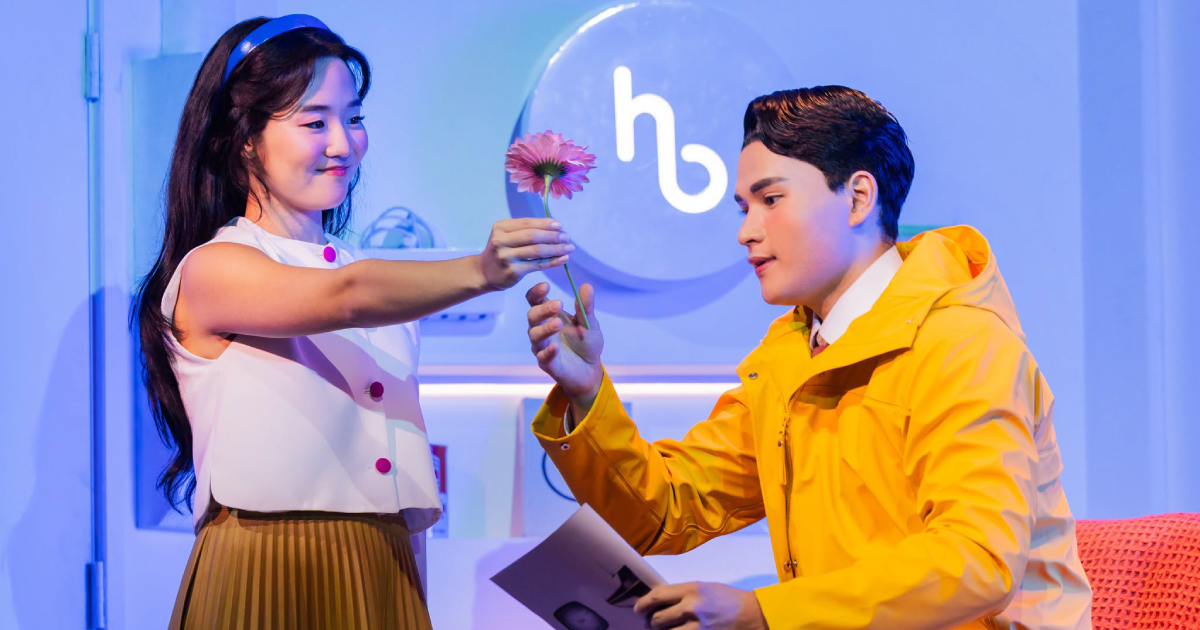
A digital clock and date display with Korean text situates us in Seoul in 2064. Oliver and Claire occupy small, tidy rooms in a comfortable retirement village of sorts for obsolete, increasingly antique Helperbots. Oliver awaits the return of his former owner, James, tending the plant James gave him and listening to his records by mid-century crooner Gil Brentley. More advanced but equally discarded and literally running out of battery power, Claire regards her neighbor’s attachments with skepticism informed by her own experience of humans.
Their differences emerge slowly, and for a considerable stretch, their predicament is easier to understand than to feel. The story gains emotional traction when they leave their separate compartments on a joint adventure to Jeju Island, where Oliver hopes to find James. At Motel Sexx, their awkward attempts to impersonate a human couple finally draw us close.
Their connection, and therefore the audience’s connection to them, deepens with “How to Be Not Alone,” which acknowledges companionship as something requiring effort. Its awkwardly phrased title gets at a primal challenge: learning how to accommodate another presence in a life more easily arranged around solitude.
This delayed emotional investment is a weakness in so spare a story. Yet once the relationship takes hold, the musical explores love with an appealing resistance to sentimentality. The bots have a shelf life, and affection cannot extend it indefinitely. Late turns suggest echoes of Romeo and Juliet and Eternal Sunshine of the Spotless Mind, though these implications pass swiftly through a show whose touch remains light and playful. Its most resonant suggestion is that an ending cannot determine the value of everything preceding it. Love’s impermanence does not diminish its worth.
Under Michael Arden’s direction, the production’s technical elements give these modest lives extraordinary scale. George Reeve’s video design and Dane Laffrey’s scenic and additional video design keep the stage in fluid motion. Illuminated frames expand and contract around the action, making the boundaries of the bots’ worlds visible.
A more traditional suspended picture frame reveals Oliver’s remembered life with James, moving scenery and video, bringing the past into tangible proximity. Elsewhere, memories expand across the proscenium, particularly powerfully in Claire’s recollections of her former owners. These heartbreaking films reveal how earlier experiences of intimacy and disappointment shape the bots’ expectations of each other and the pursuit of love itself.
On their road trip, streaming cityscapes create wonderful movement around an imagined car center stage. Later, a digitally shared memory opens into an enchanted forest of fireflies, with the seven-piece orchestra, led by conductor and music director Josh Tatsuo Cullen, visible amid the glow. It is absolutely gorgeous. So little happens physically, yet the world on stage ultimately feels enormous.
The performances give this elaborate machinery its warmth. Steven Huynh’s Oliver has a puppyish eagerness, especially when he mistakes all passing humans for James, prompting Claire’s hilariously offended correction. His reflexive “You’re welcome” to any expression of thanks is another lovely detail, betraying his programming even as he attempts to pass for human.
Claire Kwon provides an engaging counterweight to his optimism, while their lovely duets allow tenderness to emerge through especially pleasing harmonies. The score’s individual melodies and lyrics are less memorable than the sound of their voices coming together.
As James and his son, Junseo, James Seol beautifully captures the distance between Oliver’s joyful memories and the more complicated human relationships beyond them. His performances allow affection and disappointment to coexist without canceling each other out.
Francisco Javier González brings a phenomenal voice to Gil Brentley, whose nostalgic interludes supply a vocal glamour that feels like big Broadway within this otherwise intimate musical. The connection between the musical interludes and the action is sometimes elusive, but the contrast is intriguing: an assured romantic voice from the past punctuates the experience of beings tentatively inventing their own future informed by the nostalgia of an imagined past.
Running under two hours without an intermission, “Maybe Happy Ending” feels slow to open and fleeting once it does. Its storytelling does not always match the emotional force of its extraordinary images. But its interplay of technological spectacle and familiar longing makes for something fresh, thoughtful, and frequently lovely.
Maybe Happy Ending
Broadway Grand Rapids
Nov. 10-15
grandrapids.broadway.com