
Western Michigan University’s Department of Dance is world class, and their Winter Gala Dance Concert showcases the extraordinary and collaborative talents and terrific professionalism of its students, faculty, and guest choreographers.
This year’s Gala feels more like a deliberate concert than a showcase recital. In two acts, two and a half hours, and eight dances, each piece is distinct yet also blurs the distinction between dance styles and speaks surprisingly lucidly to the current cultural moment.
For example, many of the pieces distinctly feature dancers collapsing onto the ground. Is this not how we, collectively, feel? We’re not doing it nearly as elegantly and skillfully as they are, but in the falling down, and the getting up, and the falling down and getting up again, beautifully and artfully, and in several different contexts, we see ourselves—with a touch of hope.
But dance is ephemeral and its powerful effects are so much more about how it makes us feel rather than what it says, and these dances are wonderfully, eclectically evocative—a celebration of dance itself, and the ways it is shaped by and in conversation with other artists and art forms.
Peter Chu’s impressionistic Breathing Echoes is not only set to several of Jeff Buckley’s lesser-known tunes, the dancers (who, yes, all fall down at the start of the piece) ultimately embody the rhythm, the resonance, the shape of this singular vocal stylist’s singing—21 dancers in three groups stomping, wavering, lilting, shaking—and at turns offering grounded, seated, gliding, sliding, rolling pas de deux and others in which one guides the movement of another in a marionette-like fashion with a stick.
Four Seasons can’t help but nod to Vivaldi and the many ballets that have been choreographed to this iconic work, though Seyong Kim’s version is set to the likes of John Travolta and Nancy Sinatra. And while it also nods to classical ballet with two ballerinas dancing in tandem en pointe (the only pointe work in this show), it’s largely playful and experimental, shot through with a musical theatre ethos with sections in which the larger corps rocks out together, and a contemporary pas de deux set to “Bang Bang”.
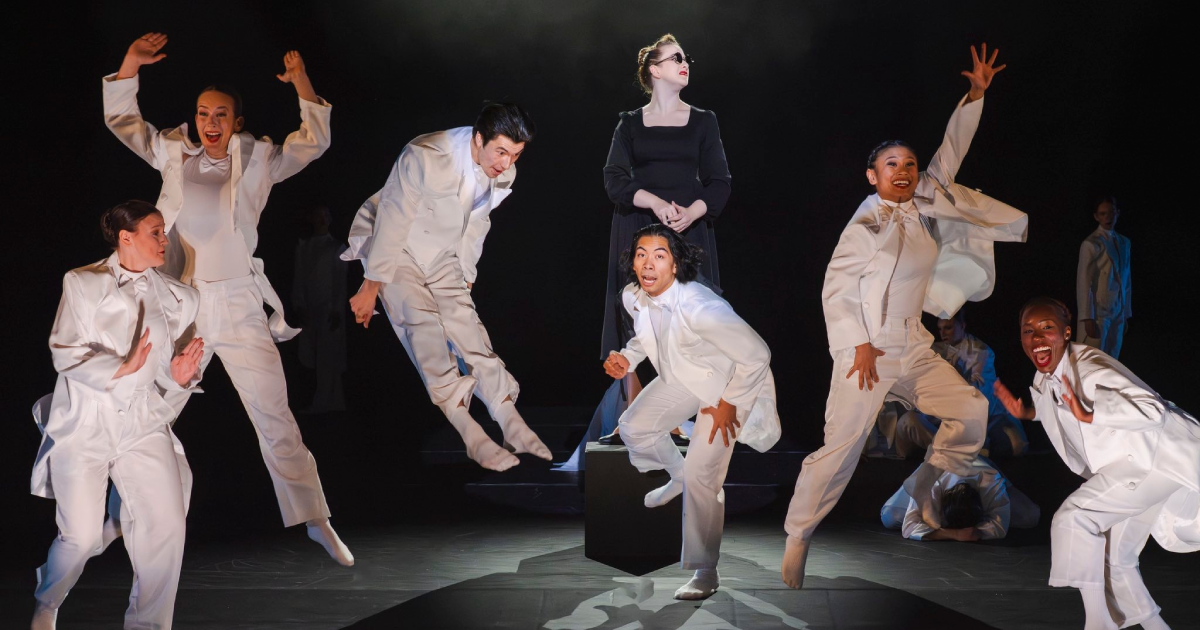
Annalee Traylor’s Crossing Over takes theatre dance to the next level with an actor leading the charge, walking and speaking to the “dearly beloved, we are gathered here today to get through this thing called . . .”, borrowing directly from Prince’s Purple Rain. More than a dozen dancers dressed in white tuxedos jump, shake, quake, and clap while also making nonsensical vocalizations. It’s silly and strange, relying heavily on the Matthew Wilder’s “Break My Stride” for emotionality, and by the end of the piece, they’re on their knees tossing oversized glitter toward the audience. Whereas Mike Esperanza’s Nocturnal Animalsturns the stage into a sexy, slightly sinister, underground nightclub scene, complete with pantsuits, sequins, and provocative lighting design by Evan P. Carlson that becomes part of the choreography as dancers move a floor light panel on wheels around the stage.
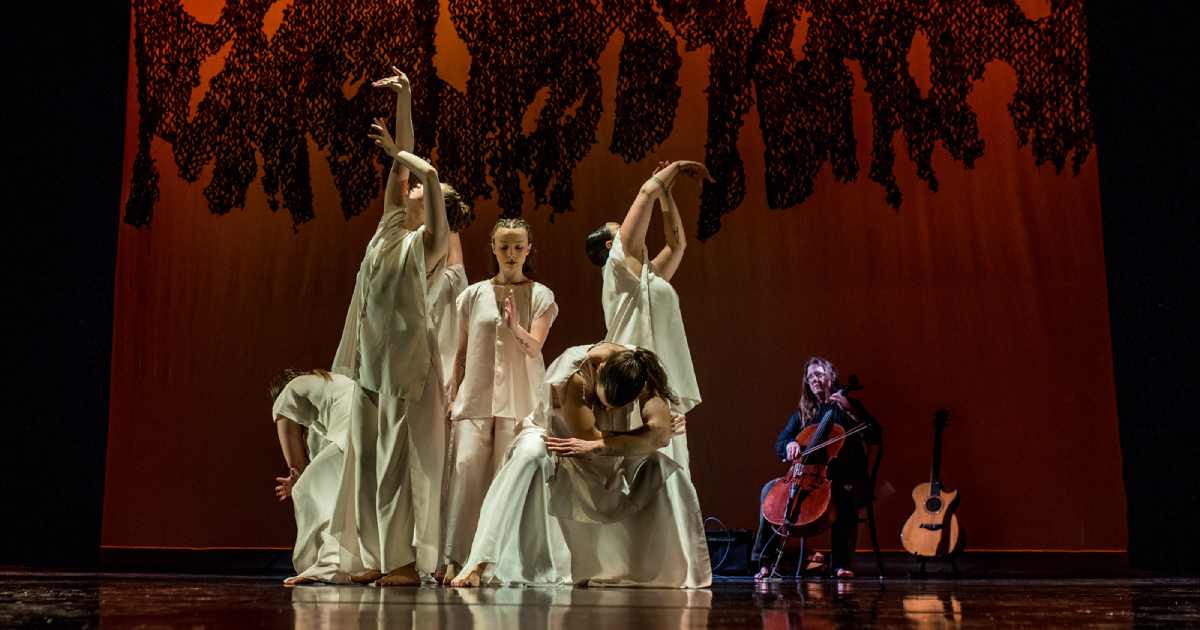
Other pieces make wonderful use of grand formations, from Andi Salazar’s dark, dramatic At Midnight in which 20 dancers begin center stage in a cluster, like a knot, from which a soloist emerges and is ultimately held overhead—two moments between which lifting, carrying, dragging, and falling down abound—to Noelle Kayser’s Anonymous, an elegantly rhythmic and mesmerizing militaristic showcase of the Western Dance Project.
However, most memorable are the opening and closing dances of the show. Kesley Paschich’s What Once Was is a visual delight, a gorgeous marriage between dance, costumes (Julia Kosanovich), and lighting design (Evan P. Carlson) in which white tutus lit from within are suspended like lampshades, mirroring the dancers themselves, wearing gorgeous tutus, while projections of small images of light speeding across the cyclorama also mirror the movement of the dancers. Part industrial and mechanical with sharp arms, part classical variations, including a nod to La Bayadere’s Entrance of the Shades, it’s an extraordinary piece.
And the Gala ends on an utterly joyous high note with Monique Haley’s Groove’s Lullaby. Set to Amaro Freitas’s “decolonized” Brazilian jazz, this colorful piece celebrates African dance stylings with high energy, upbeat undulations, clapping, and onstage drumming and percussion. With lively pas de deux and pas de quatres as well as bright, tireless solos, it’s a warm, delightful conclusion to another very strong showing from WMU’s most excellent dance department that celebrates the possibilities of the art form as well as the many emotions and sensations it inspires.
Despite its ephemerality, how dance makes us feel is lasting.
Winter Gala Dance Concert
WMU Department of Dance
Feb. 13-15
wmich.edu