

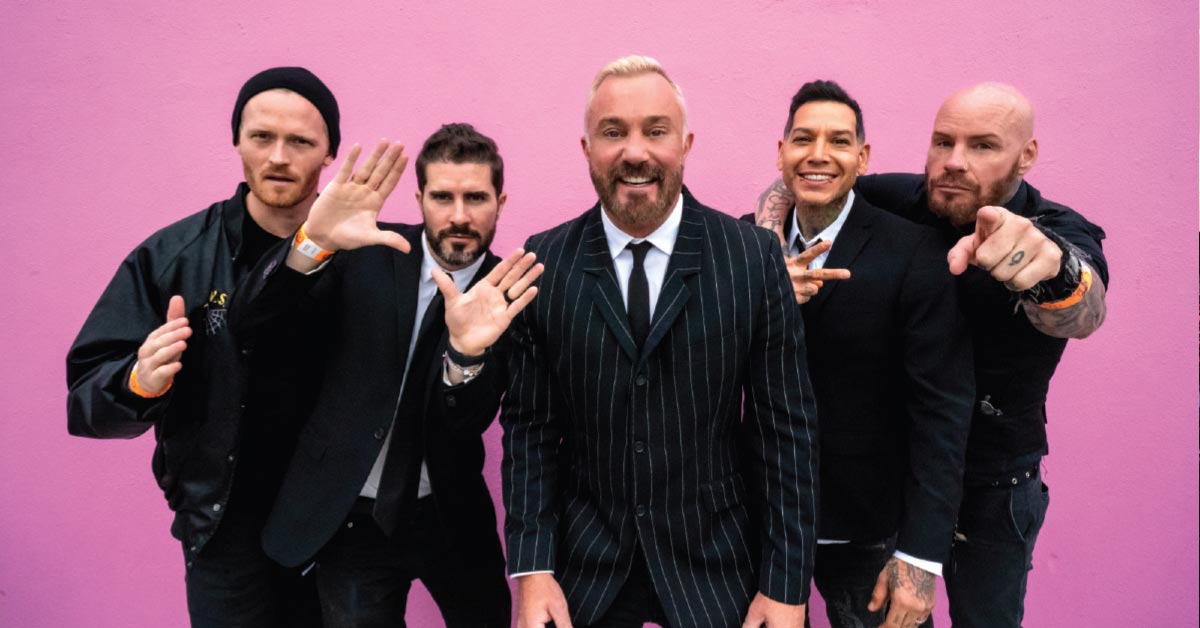
For more than three decades, Goldfinger has thrived on a joyful chaos—the kind that leaves stages soaked in sweat, horns blaring, guitars buzzing, and crowds bouncing like it’s 1996 again.
And in a way, for Goldfinger, it kind of is.
Not in a purely nostalgic, stuck-in-time sort of way, but how the same restless energy that helped define the band during the ska-punk explosion of the mid-’90s continues to fuel them today.
And with the release of their ninth full-length album, Nine Lives, back in January, that energy feels as vital as ever now in 2026.
So it’s fitting that a band synonymous with endurance, reinvention, and unpredictability would land on a title like Nine Lives. Because if there’s one thing Goldfinger guitarist Charlie Paulson knows for certain, it’s that longevity in punk rock is never a guarantee.
“Oh, for sure,” Paulson said with a laugh when Revue asked if the band has nine lives. “Especially me… somebody screenshot something and sent it to me. There was a comment on some YouTube Goldfinger something, and it said, ‘Charlie comes and goes as he pleases. He’s kind of like a house cat.’ So, Nine Lives specifically for me, yes.”
Formed in Los Angeles in 1993, Goldfinger emerged alongside genre-defining peers like Rancid, No Doubt, Sublime and others, helping to push ska-punk into the mainstream with upbeat rhythms, sharp hooks, and an irreverent sense of humor.
Their breakout single, “Here in Your Bedroom,” off their 1996 self-titled debut album, became an alt-rock radio and MTV favorite, launching the band into relentless touring and a reputation for explosive live shows—including a Guinness World Record for performing 385 shows in a single year.
But now, Paulson admits it’s hard to fully grasp the band’s legacy.
“It’s hard to see it from the inside,” he said. “We played Warped Tour last summer… we were one of the senior bands on that bill. And (bassist) Mike (Herrera) and I were walking through the crowd, and almost nobody approached us. But then we went back into the artist area, we were getting stopped every five feet by younger bands.”
What struck him wasn’t just the recognition, it was hearing the lasting and far-reaching impact his music has had.
“Bands that sound nothing like us… emo bands, metalcore kids, are like, ‘Dude, I learned how to play guitar listening to you.’ So, it’s hard to put a finger on it, because the influence is definitely undeniable.”
One of the band’s biggest breakouts came with the inclusion of arguably their most ska-punk song, “Superman,” the opening cut from their second album, 1997’s Hang-ups, in the wildly popular video game Tony Hawk’s Pro Skater. That featured appearance, as well as several popular covers, broadened their reach, and kept them touring steadily even as the radio and music industry shifted in the new millennium.
But back in the early days, that long-lasting success felt anything but inevitable.
“No, absolutely not,” Paulson said of whether he imagined doing this 30 years later. “What we were doing was not popular… every other band wanted to be Soundgarden or Weezer. We were doing it because, frankly, we just loved it.”
That DIY ethos still runs deep in Goldfinger’s identity, even as their audience has grown into the hundreds of millions of streams and a multi-generational fanbase. Today, the band boasts more than 1.5 million monthly listeners on Spotify, along with a substantial social following that continues to expand as new fans discover their catalog.
“We’ve got like nine albums to choose from at this point,” Paulson said. “Plus a cover EP… and people really seem to dig that too. So it’s hard putting a set list together. You want to give a little bit of shine to the newer stuff… but you also know people want to hear what they grew up on.”
If there’s one place where Goldfinger’s legacy truly comes alive, it’s on stage.
Songs like “Mabel”—which Paulson admits he initially “didn’t think would become much of anything”—have taken on a life of their own, evolving into crowd singalong-anthems that long since outshined their chart performance.
That sense that anything can happen in the moment remains central to the band’s appeal, and it’s exactly what fans in West Michigan can expect when Goldfinger headlines this summer’s Ska The Lot.
Set for June 27 outside The Intersection in Grand Rapids, the event promises a stacked lineup celebrating ska’s past, present, and future—with Goldfinger firmly positioned as both torchbearers and instigators.
“We’re really looking forward to it,” Paulson said. “A lot of great bands on that bill. And I’ve always loved that part of the country… you guys gave us Motown. You gave us the Stooges. You gave us the MC5. You gave us the White Stripes.”
These days, Goldfinger operates a little differently than in their touring heyday. For Paulson, it’s also about health and sustainability.
“We still treat a Goldfinger show like a boxing match,” he said. “We take really good care of ourselves… it’s as much a performance as it is playing music. And we still want to be able to do that for years to come.”
That mindset extends beyond the band, too. Whether producing younger artists, supporting local scenes, or simply showing up at small shows, Paulson remains deeply connected to punk’s grassroots energy.
“That’s what keeps punk rock exciting for me,” he said. “I can go see a huge show… but the spirit is different than what it is at a backyard show. That’s where I find a real connection these days.”
It’s that same spirit—unpolished, passionate, and in their own way unpredictable—that continues to define Goldfinger. Because for a band that never thought they’d last this long, Nine Lives isn’t only a milestone.
It’s proof that they’re very much still alive.
Goldfinger – Ska The Lot
Wsg. Mustard Plug, The Suicide Machines, Five Iron Frenzy, Catch 22,
The Boy Detective, sullvn.
The Intersection (outside in the parking lot), 133 Cesar E. Chavez Ave. SW, Grand Rapids
June 27, 3p.m. doors, 4 p.m. show, All Ages, SOLD OUT
Goldfingermusic.com, Sectionlive.com
