

Holland offers such a beautiful landscape,” said Jaer Medina. “I don’t know that you could ask for a better place for an artist to grow up, outside the Swiss Alps.”
An artist himself, Medina grew up in Holland before attending Grand Valley State University. While earning a BA in Visual and Media Arts, he worked at Target, a job which left plenty of time to think. Seven or so artists worked there, too; on break, they would talk about art.
Medina later created an exhibition titled “On Pace.” It explored what it was like to work at Target—in particular, to work there during the pandemic. Afterward, as he took the work down from the walls, it occurred to him that he could do this sort of thing again.
He started The Garage, an exhibition space in his literal backyard. And he invited others along. “Being an instigator is my role. My personality lends itself to organizing. There’s something cool about not just making your own work but organization the space where people’s work can be seen.”
There was a practical element to the decision; no one was rushing to give young artists precious gallery space, not in Holland. And staying local was important to Medina. He was skeptical of the prevailing arts world view that West Michigan was nothing more than a point on the map between Detroit and Chicago. It had something valuable to offer.
After his senior year, he received a grant and attended a conference. He walked away with a renewed sense that the Midwest was nothing like the cultural wasteland as which it had been seen, and that community spaces mattered. “But I was only doing that three months out of the year, the warm months,” he said. “Nobody wants to spend time in a cold garage in Michigan.”
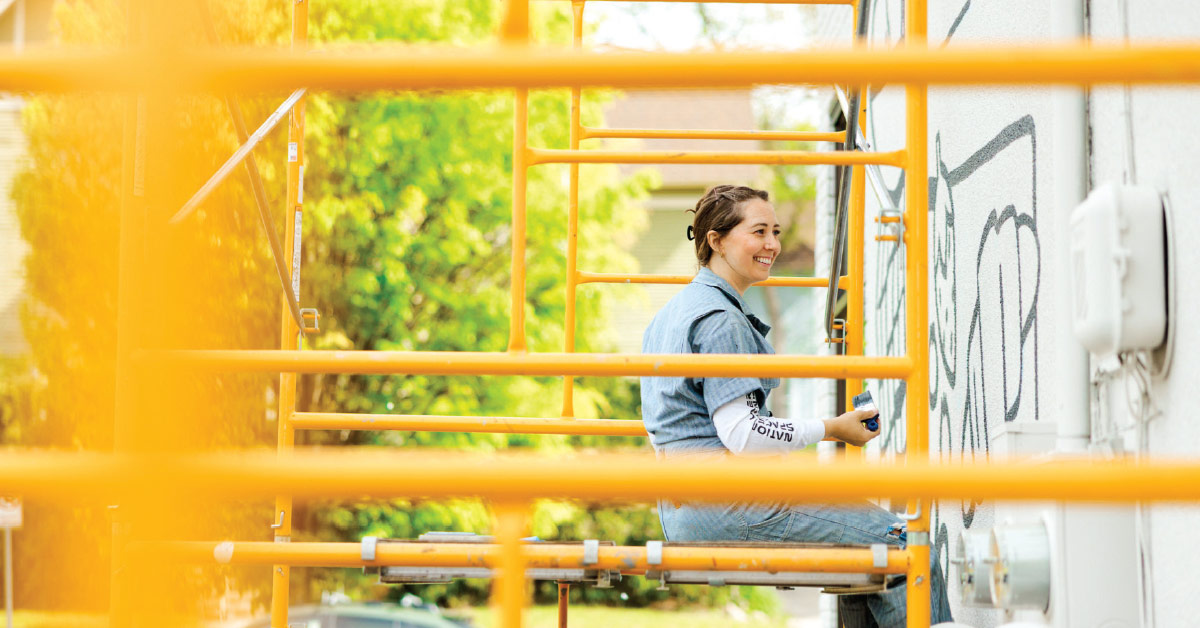
He found space in a building on 19th and Columbia, a small industrial pocket of Holland. Elbow grease and dedication saw the transformation of that space into CREA (Comunidad de Reflexión Experimental y Artes) a new initiative; friends and fellow artists Madai Huerta and Ava Kathryn joined him in it.
What is it? A community space for art, in particular local art. One representative project: a local history booklet documenting the lives of Mexican-Americans who lived in Holland in the early 20th century. “It’s a pretty under-researched topic,” he said. “Printing it there, we don’t have to wait for a publisher.”
Another hyperlocal project involved food criticism. A friend who asked to remain anonymous had eaten tacos at a local Mexican restaurant. They were good, but they weren’t what they were advertised as. “If you say you’re selling al pastor, you’ve got to be accurate.” The result was both a piece of hyper-local food criticism and a personal story at once. Medina said it spread throughout a 15 to 20 block radius of the studio.
CREA hosts exhibitions and informal educational sessions. For one exhibition, “The Free Soil Potboil,” an artist who had grown up in the area used ancient Indigenous free soil made from clay, straw, and dirt, transforming them into beautiful sculptures. “Something as simple as soil can become artful material. What else is on our backyards, homes, garages?”
CREA has a risograph printer, a machine bridging the gap between a photocopier and a screen printer. Using it allows artists to show their art to those who can’t or don’t make it to exhibitions. “It’s something you hold in your hand,” Medina said. “Something you give people.”
A recent initiative is CREA Conversations, which helps spread the word about others doing work in similar veins. CREA’s website links to an essay on Grand Rapids’ Veil Collective, another organization dedicated to fostering an artistic community. Another essay presents a conversation with Hugo Claudin of Artside Gallery.
Each of the three artists behind CREA works other jobs. “We do this in the margins,” he said. They’re committed to the idea that art that matters can happen here, created by people we know. “I don’t subscribe to the idea that important cultural work starts in major cities and flows out,” he said. “I’m interested in reversing that flow.”
It may be that childhood experiences contributed to his sense that things can be different than they are today. “I grew up Latino in Holland, a place that holds onto its Dutch heritage pretty strongly. I appreciate that. And, as a person of color, it gave me a sort of inside-outside perspective. That’s really fun.”
Today, the organization he instigated offers art to those who want it. “I’d be lying if I said the whole neighborhood shows up for our events, but I don’t know that I’m so worried about that. If one person really enjoys themselves and understands the show… that, for me, is a success.”
Early in its life, CREA’s already had many successes. Bringing people together: an organizational goal that seems to come naturally to the artist. “Community is just what I do.”
Check out CREA's events like Open Print, which let you experiment and learn how to use a risograph.
Learn more at crea-holland.cargo.site or on Instagram @creaholland.