
Joy, darkness and some particularly unsettling ghosts took the stage as H2, Hope College’s pre-professional dance company, opened its fall concert Halloween weekend at Knickerbocker Theater in Holland.
Across three very different works, the program offers a striking range of what women’s bodies can express: exuberance and pleasure, turmoil and connection, and, ultimately, resistance to the roles prescribed for them.
That range begins with the sheer joy of Pulse of Niterói, choreographed by Martin Tre Dumas, III, a colorful tap piece performed by four women in bright tops and black pants. Buoyant and rhythmically playful, the piece revels in the percussive possibilities of the dancers’ bodies—the quick conversation of feet, music and movement creating an infectious sense of pleasure.
It is also a welcome reminder of how exhilarating tap can be, and how rarely we seem to see it on concert stages anymore. Nearly three decades after Savion Glover helped propel a tap resurgence into popular culture, Pulse of Niterói made a persuasive case for the form’s enduring vitality in that these women don’t just create rhythm; they delight in what their bodies can do.
In stark contrast, The Illuminator shows twelve female dancers, barefoot and dressed in loose-fitting pants and tops, moving through a kind of organized chaos, falling and rolling, punching and kicking, tumbling and writhing to a dissonant soundscape with an almost apocalyptic quality. Hair-flipping, headbanging, stomping and shouting heightens the agitation, even as the dancers hold hands, lean against one another and share weight in shifting formations.
The tumult becomes more legible in a series of tableaux as they voice emotions in the body: shouting out “fear in the face, rage in the arms, joy in the legs” and “grief” in the arms and face. The words suggest an exploration of how emotion is carried and expressed in women’s bodies. When the soundscape abruptly shifts into upbeat house music, the ensemble moves together in formation, clapping and shaking; and the sudden joyfulness offers release from the dissonance that precedes it.
Questions about what women carry in their bodies takes on broader cultural implications in A Woman’s Place, the new work the company will take to the Edinburgh Fringe Festival next summer that made up the entire second act of this performance.
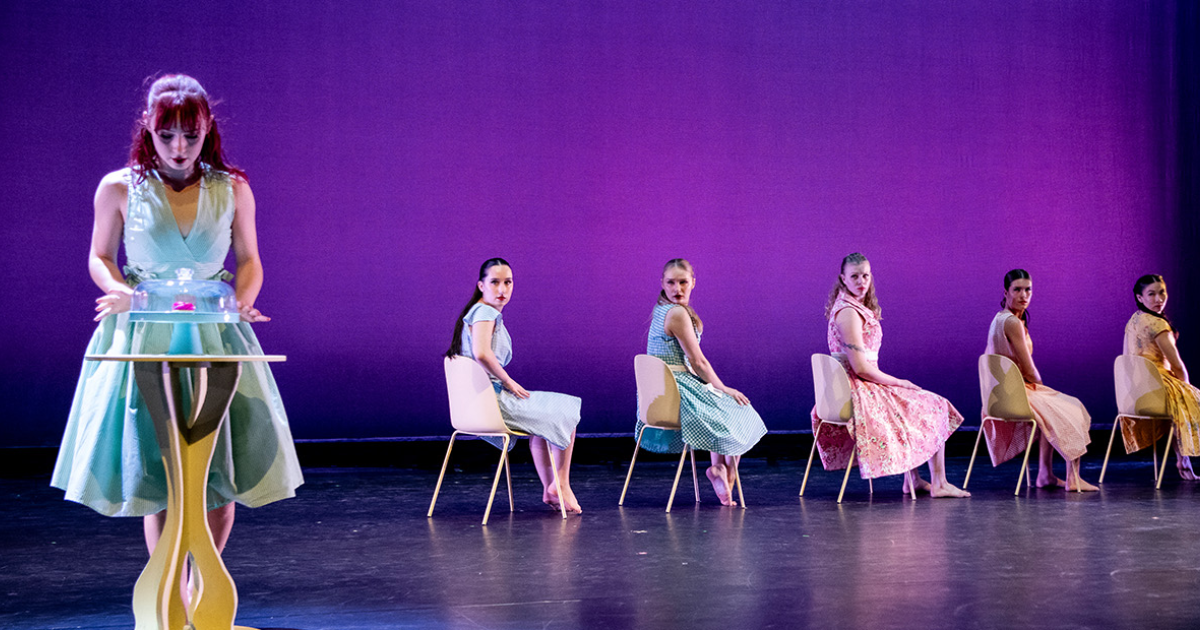
Shifting the focus to the forces that have long sought to prescribe what women’s lives should look like, the piece conjures a world of pastel house dresses, domestic labor and beauty norms. It is the evening’s most haunting turn.
The frightening thing about this resurrection of the 1950s is how little of it feels safely in the past. Through their bodies, the young dancers confront the stubborn persistence of gender expectations that a supposedly “post-feminist” culture might have been expected to leave behind. What begins as playful, occasionally obvious satire gradually acquires a more troubling resonance in the age of the tradwife.
Choreographed by Kara Brems and Jasmine Mejia in collaboration with the dancers, A Woman’s Place builds its argument through an inventive collage of contemporary dance, archival recordings, interviews, popular music and props. It opens playfully, with a male and female dancer performing to a recording of Mel Brooks and Marlo Thomas’s bit “Boy Meets Girl,” initially dressed in pink and blue T-shirts before stripping them off to reveal the opposite colors underneath.
But the comedy soon gives way to vintage admonitions about how boys and girls should behave, dating, and beauty, as women in pastel house dresses mime the repetitive work of applying makeup and keeping house while the lone male dancer sits downstage in the flicker of a television.
The accumulation is the point: domestic labor is a project, but so is the female body, and neither job is ever finished. Feather dusters, brooms, mops, rubber gloves and cleaning rags become choreographic props—the women even twirl the rags overhead like lassos—while a hilarious sequence about housework explodes into the irresistible beat of Jax Jones’ “House Work.”
One of the evening’s sharpest images comes when the women gather almost reverently around a cupcake beneath a glass dome, wanting but resisting it, until the man simply walks over and eats it.
As the dancers shed their house dresses, petticoats, and bustiers for nude-colored bra tops and shorts, the satire darkens: stripped of the costumes of prescribed femininity, their bodies reveal another form of confinement—the relentless expectations attached to being female. The prison isn't merely the house dress or the domestic role; it extends to appetite, appearance, sexuality and the body itself.
Recorded voices bring the critique into the more recent past and present, addressing women’s access to credit, Gloria Steinem’s recollection that girls were asked when they would marry while boys were asked what they wanted to become, and the persistent imbalance of domestic and invisible labor, especially as women have entered the workforce, work full time outside the home, and are paid less for the same labor done by men.
The piece’s initially broad satire accumulates into something considerably more sophisticated and devastating. A voice over calls for a more equitable society for all which is embodied in a weight-sharing cluster of dancers through which the lone man moves, supported and carried largely by the women around him.
In its deft combination of humor, movement, music and cultural critique, A Woman’s Place makes an ambitious—and distinctly American—work to carry to an international audience at Edinburgh.
The excellence of A Woman’s Place is both unsettling and timely. These young dancers are embodying struggles over women’s work, bodies and freedom that should, by now, feel more historical than contemporary. Making that argument through dance gives it particular power, with young women’s bodies serving as both the site of the struggle and the means of resistance.
At a moment when traditional gender roles are being repackaged and celebrated anew—and when women continue to confront questions of bodily autonomy, safety, and whose desires matter—the ghosts summoned onstage refuse to stay in the past.
A Woman’s Place asks what it would mean for women to live with true sovereignty—with real freedom—unburdened by demands about who they should be and what they should do. The question it leaves us with is more disturbing than anything conjured for Halloween.
How much has really changed?
A Woman's Place
H2 Dance Company
Hope College
Oct. 30-Nov. 7
hope.edu