

Djanet Sears’ award-winning 1997 play Harlem Duet imagines Shakespeare’s Othello’s first marriage, before Desdemona, embodying and centering his Black first wife’s experience.
Sometimes referred to as a prequel to The Bard’s 16th Century tragedy, this brilliant work plays with the silences in Othello while riffing on many of its themes, offering a jazz-like, non-linear narrative irrelevant to chronology that raises questions about who Othello becomes and why, while also giving powerful voice to Black women, who are absent in the Shakespeare play.
In short, it’s poetic genius, an important, thought-provoking, heartbreakingly truthful, entertaining work of art to kick off Kalamazoo’s Face Off Theatre Company’s 11th season.
Set in three pivotal time periods in American Black history, the story is anchored in 1997 Harlem, at the symbolic intersection of MLK and Malcolm X boulevards, where, amid the Black sanctuary set against the backdrop of the Million Man March, the 9-year marriage of two intellectuals is crumbling.
Othello, a professor at Columbia, is leaving Billie for his white colleague, Mona. Billie’s rage, despair, and jealousy is rooted in so much more than this singular event, and the context in which the layers of love and betrayal emerge through parallel scenes featuring symbolic Othello and Billie as slaves plotting their freedom in 1860 and a classically-trained actor forced into performing minstrel shows during the 1920s Harlem Renaissance.
In each period, Othello’s yearning to fully access the white world and internalized racism leads to the betrayal that ultimately causes Billie’s descent into mental illness. The intersectionality of race, gender, sexual politics, generational trauma, and how it shapes identity is deftly and poetically explored, particularly in the capable hands of Director Quincy Thomas and the excellent cast and crew of this impactful production.
Though Stacy Bartell’s set pieces are simple, every scene is distinct and clear in space and time thanks to full use of the Nelda K. Balch thrust stage and surrounding areas with excellent lighting and sound by Eric Batts, including projected images with dates, and music featuring jazz, blues, Motown, and hip hop as well as clips of speeches including those from MLK, Jr., Malcolm X, Paul Robeson, Abraham Lincoln, and JFK for transitions. Long scene changes at times dragged down the momentum of the narrative, but the dramatic effect of hearing historic cultural snippets matters.
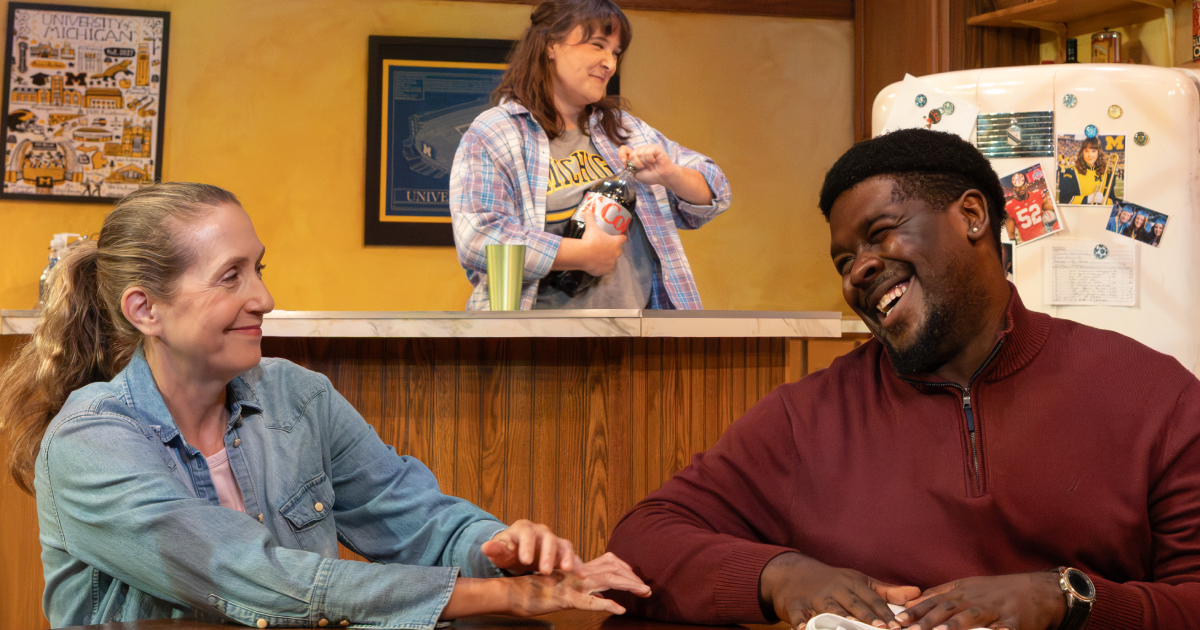
The cast of six works magic with this extraordinary script, milking every nuance, every layer of meaning from this powerhouse of a story. Xavier Bolden is a tremendous Othello, distinct in each iteration, his heartfelt conflicts palpable. He and Alyssa Laney as Billie have wonderful chemistry together, and even though it’s her consequences from his destructive choices at the center of this tale, he’s never a villain. The forces at work are too complex, and their performances maximize that complexity with their genuine humanity.
Anna Cafagna’s Mona is appropriately on the margins; Kennedi Wheeler’s Magi is both hilarious and wise; Shea-Lin Shobowale-Benson offers a grounding force as Amah, and Vic Ledbetter is a charming Canada, Billie’s estranged father who shows another layer of generational trauma but also offers powerful healing.
Harlem Duet premiered in Toronto nearly 30 years ago; remarkably, in 2006 it was the first Black work to be produced at Ontario’s Stratford Festival, and in 2022 it was the first Black work featured at Vancouver’s Bard on the Beach festival. These are undoubtedly frustrating firsts that echo a central question raised in the play about how much racial progress has actually been made, from after the Emancipation Proclamation to after the Civil Rights era, the sexual politics of masculinity for Black men has a devastating effect on Black women.
Thanks to Face Off Theatre Company in collaboration with Kalamazoo College for giving what appears to be the first Michigan production of Harlem Duet to local audiences, celebrating Black artistry and Black experience, inviting us to appreciate the complexity and poetry of this story not nearly told often enough, to better recognize the truth of its injustice, and to experience hope for potential healing.
Harlem Duet
Face Off Theatre
Sept. 11-20
faceofftheatre.com/