

Asked why live music mattered to him in a 2010 Boston Globe interview, renowned American choreographer Mark Morris said, “Wouldn’t you rather have live people doing something?”
Sixteen years and an AI revolution later, it feels even more necessary and restorative to bear witness to very alive humans doing together what only humans can do for a live audience of other humans eager for connection.
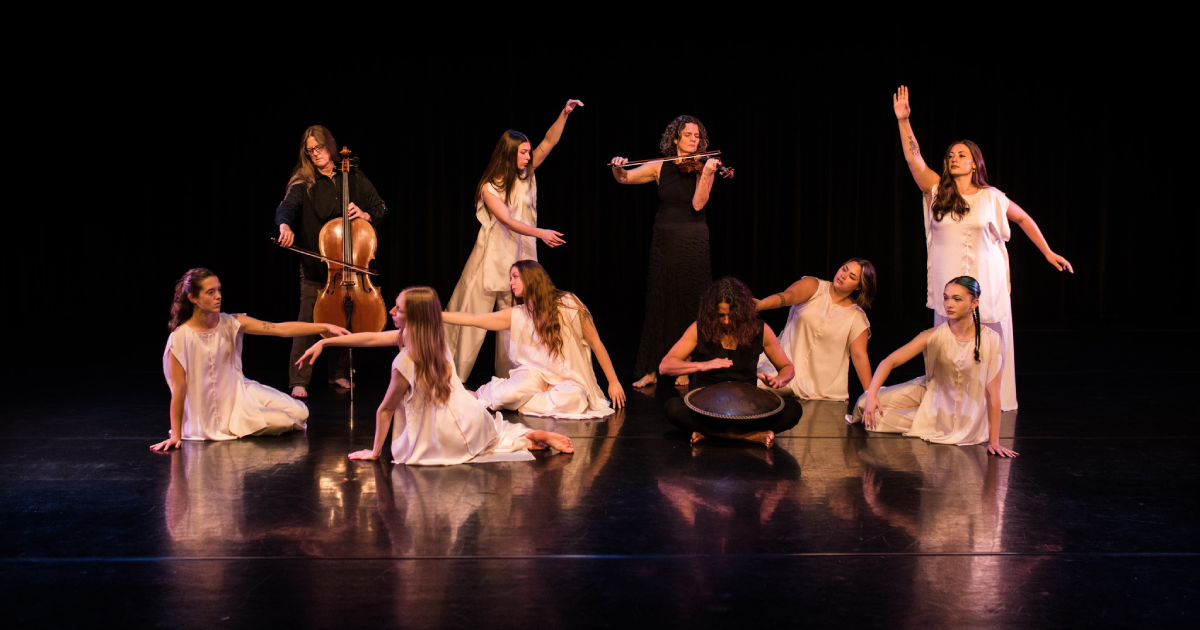
“Tendrils”, Wellspring’s Fall Concert of Dance, a collaboration between the modern dance company of seven women with the improvisational trio of musicians Aurora & Antheia offers the pleasure of human connection and live performance in ways unique to their art forms.
During a talkback after the opening-night performance percussionist Carolyn Koebel described what happens when she plays for the dancers as a “somatic response”, and it was embodied in the performance as part of the dance itself.
In Cori Terry’s “The Forest Is a Goddess,” Artistic Director Marisa Bianan sat downstage and turned to face Koebel, who was seated upstage facing the audience. Bianan moved her hands as though she were moving the energy between them. The light shifted dramatically, and the drummer’s movements were as evocative as the dancer’s.
That give and take runs through “Tendrils,” a reprise of Wellspring’s 2024 concert with the addition of Bianan’s premiere “Glaciers.” The program mirrors nature itself as a forest, moving from tendrils and mycelium to entwined vines, a swamp, a forest, and glaciers before returning to Terry’s “Tendrils.”
The ten pieces, some for music alone, are interdependent and flow into one another. The concert takes on the character of an ecosystem, with each part depending on what happens elsewhere onstage. A dancer’s gesture can prompt a musician’s response, and a change in the music can set the dancers in motion.
Wellspring is known for its collaborations, and here the music, movement, costumes, and lighting are unusually and beautifully impossible to tease apart. Cellist Laurie Jarski, who also plays banjo and guitar among other stringed instruments, violinist Cori Somers, and Koebel play upstage beneath tattered camouflage netting painted green and gold. The netting catches the light as lighting designer Samantha Snow washes the cyclorama in shifting jewel tones. Patricia Plasko’s cream-colored tunics and flowing pants are slit up the sides, and the fabric opens and falls as the dancers turn, catching the light and extending the movement.
There’s often a sameness to Wellspring’s choreography, rooted in Erick Hawkins’s style, whether from Bianan or Terry. The dancers run, twirl, reach and contract, and rarely get far off the floor. In “Entwined Vines,” those familiar movements gain interest from what the dancers do with one another. They lean into each other and pull in opposite directions, trusting one another with their weight, while little lifts and sweeping port de bras carry the eye from one body to the next.
Bianan’s “The Swamp Over Eighth Street” makes especially good use of the floor. Following a violin solo by Somers dedicated to Michael Miller, a longtime Wellspring dancer who died recently, six dancers walk and crawl onto the stage and settle on their sides. Recorded frogs and percussion that sounds like rain accompany barely perceptible rises and falls.
The dancers gather in a line on the floor, and a seventh tiptoes around them before lying across them. They roll like kids playing steamroller, and she rolls in the opposite direction. Then she rises and walks over them, with each dancer seeming to come awake in turn. The light brightens, the banjo and drums pick up, and soon they’re running, twirling, and hopping. They form a circle, reach out to connect, and all fall down.
“Glaciers,” the evening’s only premiere, brings back the guttural rumble of the taiko drum heard in the 2024 concert. In dim light, the dancers writhe and reach. One stops downstage center and sways as others come and go in a series of pas de deux. As the guitar and drum grow louder and the violin wails, arms grow more angular, spines undulate, and the five dancers run in a cluster. The piece is most compelling when those five seem to breathe together.
In the closing reprise of Terry’s “Tendrils,” three dancers sink into wide second with swimming arms, tip onto one leg, slap a thigh and hop. Eventually all seven return to a seated tableau. By then, the forest has come through in the way the performers depend on one another. The drum and banjo pick up as bodies stir, and a dance made two years ago comes alive again in front of the people gathered to see it this time.
In an age when more and more of what people do for one another can be handed over to artificial intelligence, it feels especially satisfying and even countercultural to spend an evening in the company of what Mark Morris calls “live people doing something.”
“Tendrils” shows us that despite our attempts, we are not separate from nature, and we are not separate from each other. Like the forest that depends on what grows and lives alongside it, so much of what makes us human depends on who’s there with us, what we notice, and how we respond.
Tendrils
Wellspring Dance
Nov. 20-22
wellspringdance.org
