

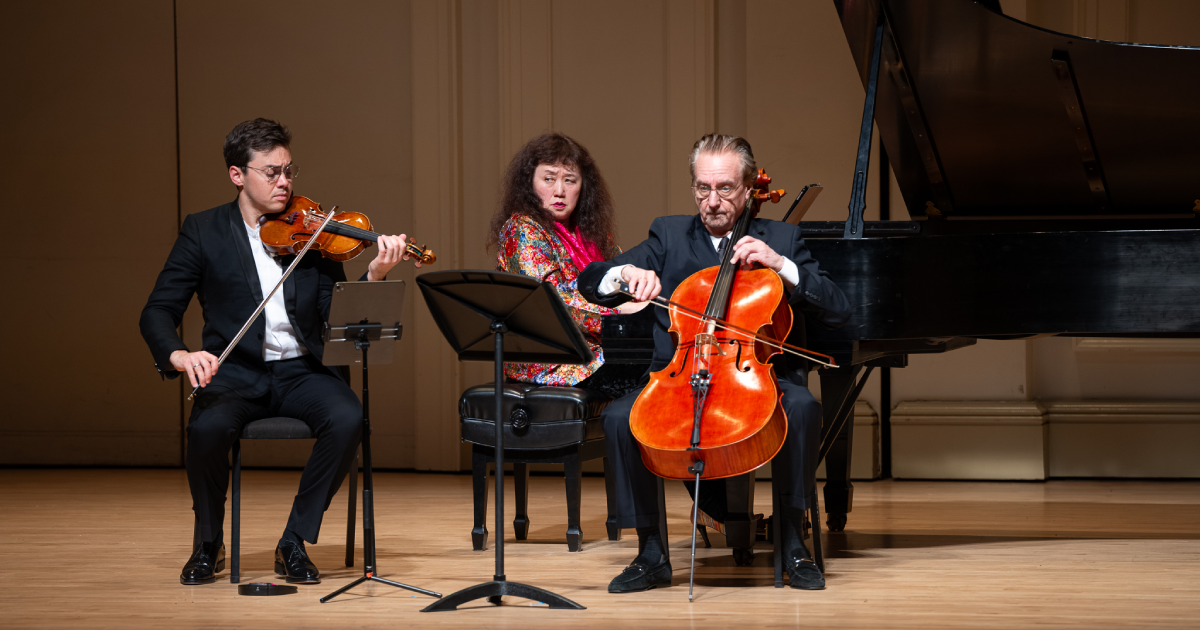
On November 12, 2012, pianist Wu Han, violinist David Finckel, and Philip Setzer performed a selection of chamber music at St. Cecilia Music Hall.
This was the first event in what’s become a longstanding partnership with Chamber Music Society of Lincoln Center. The fifteenth chamber music series kicked off on October 29th of this year; as in that first event, Wu Han and David Finckel, world-class performers and co-artistic directors of the Chamber Music Society, were once again onstage, as were other notable musicians.
For the first time, the series features not three but four concerts, a testament to the continued enthusiasm with which the community embraces these events. On February 4th, chamber musicians return for Rhapsody in Blue; on March 18th, for String Radiance; and on April 22nd for Mozart & Brahms: The Great Clarinet Quintets.
Revue sat down with Wu Han and David Finckel prior to the opening of the series in a wide-ranging conversation. The text below has been slightly edited for clarity.
Not only is this the fifteenth year of this partnership, but you’ve added on another show. What does that say about the audience in West Michigan?
WU HAN: You have to go to the origin of the project. It was a mutual desire, especially when you have an extraordinary leader like Cathy [Holbrook, St. Cecilia’s Executive and Artistic Director] who is willing, and is a visionary, and can see the value of this thing. Boom – no one ever questioned it. No one asked, do we have an audience? We wanted to bring you the most qualified musicians, the best possible music. It was as simple as that. And the audience just got bigger and bigger, and we realized we needed to do more.
There’s also a community that builds. It’s like a Mahjong club. We’re the chamber music club here. Or people who love eating food or drinking wine. Over time, you learn to appreciate subtleties. And you develop a passion.
DAVID FINCKEL: And the difference between three concerts and four is amazing. You come for dinner three times, we’re going to have pork, chicken, and steak. Now we’re saying, you’re going to have pork, chicken, steak…and fish! [Laughs]
WU HAN: And another thing is that this genre is huge. We have right now in our database over four thousand pieces. Four concerts, you’re barely scratching the surface. This year, we decided to add in piano four hand music, which we’ve never performed here. Another concert allows us to showcase more variety.
How do you determine what music to play, especially with four thousand pieces? Is it a mixture of familiar and less familiar? Is there an educational aspect to the program?
WU HAN: Always. Always. There’s always the tried-and-true masterpiece, yes. For this show [the October 29 performance], there’s the Dvořák piece, this audience will be familiar with it. But the Debussy trio was just discovered in 1980. Nobody plays that piece. Chaminade? I don’t believe the audience has even heard of this composer. But it’s such a charming piece. An entertainment rather than something more profound.
Do you see a distinction between music that’s entertaining and music that’s more profound?
WU HAN: I think every composer’s different. Gershwin’s always entertaining! He can’t help himself. And Mozart can be entertaining, too. And that’s good. You can be entertaining. You can be rowdy. But sometimes music moves into this celestial, heavenly space.
DAVID FINCKEL: When we listen to music, whether it’s new music or old music, we like music that has information—that has something to chew on. Profound music has more information.
You know, shortly before Mozart died, the grand balls of Vienna were becoming very popular. Composers were writing these waltzes, this dance music. And they came after Mozart asking for one. And he was so pissed. He was in the middle of writing The Requiem. And all they wanted were these goddamn dance tunes. But he wrote some, and sure enough, they were the best dance tunes ever written. Even if it didn’t mean anything to him, he couldn’t allow himself to do it badly.
WU HAN: [Shows a file listing the history of pieces played over the last 15 years]. This is organized by season, but look at it when organized by composer. Has Grand Rapids had too much Beethoven? Too much Brahms? What’s missing? Can we juice it up?
DAVID FINCKEL: This isn’t us lying in bed in the morning thinking, what would we like to play today? It’s, what haven’t they heard?
WU HAN: And then, in the moment, as we play, we’re aware of the audience. You can feel whether they’re listening intently. This is a great audience you have here.
DAVID FINCKEL: They applaud a lot. [Laughs]. If an audience consistently hears a high level of playing, their ears develop. You never want to put a bad player in front of someone. The ear gets dirty.
Do you feel an obligation to raise the profile of contemporary composers? Or are you simply trying to play the best music you can regardless of when it was written?
WU HAN: The second one. The quality of the music is the single most important thing. We don’t care when it was written. We don’t even care if the composer is famous or not. The music has to be first-class.
DAVID FINCKEL: Or maybe the composer’s known but the piece isn’t. [Aaron] Copeland used to complain about that, how even with great composers only certain pieces are known. We like to dig a little deeper.
Does the venue play into your decision-making? Or can you play anything at St. Cecilia?
DAVID FINCKEL: We can play anything here. That isn’t true at every venue.
WU HAN: This hall you can do anything in. Some halls are dead. That makes it very hard to play sensuous music. But here you can do anything. And we’ll bring in duos, and quartets, and sextets. No wonder we keep coming back!
The Chamber Music Society of Lincoln Center
St. Cecilia Music Center
24 Ransom NE, Grand Rapids
scmcgr.org
Rhapsody in Blue, Feb. 4
String Radiance, Mar. 18
Mozart & Brahms - The Great Clarinet Quintets, Apr. 22
